The Roots of Wine
Its Connection to Itata
More than 8,000 years ago, in the lands between the Caucasus and the Near East, humans first discovered that grapes could transform naturally. When crushed fruit was left to rest, native yeasts-initiated fermentation, giving birth to wine as one of humanity’s earliest cultural expressions. From its very beginning, wine was shaped not by control, but by place, climate, and time.
As ancient civilizations expanded, the vine spread across the Mediterranean, becoming inseparable from agriculture, ritual, and daily life. These fundamental practices—hand harvesting, simple crushing, and spontaneous fermentation—remained unchanged for millennia. In the 16th century, this knowledge crossed the ocean with Spanish exploration, bringing the first European vines to the Americas.
In Chile, the origins of the vine and viticulture took root at the foothills of the Itata Valley. As one of the earliest regions to receive vines, Itata became the foundation of Chilean wine culture. Ungrafted vines were planted directly into ancient granitic soils rich in quartz, shaped by Pacific influence and cultivated through dry farming. Bush-trained vines, small-scale agriculture, and a deep connection to the land defined winegrowing here from the very beginning.
For centuries, wine in Itata was produced from old vines and hand-harvested clusters, fermented naturally—often with whole clusters—in open vats, clay vessels, and wooden barrels. These methods were not stylistic decisions, but rather the continuation of inherited rural knowledge passed down through generations
While modern viticulture later shifted toward other valleys and industrial approaches, Itata remained largely unchanged. Its isolation and the resilience of its growers allowed both vineyards and traditions to endure
Today, the Itata Valley stands as a quiet reminder of where wine comes from—not as a product of design, but as a living expression of land, history, and time.
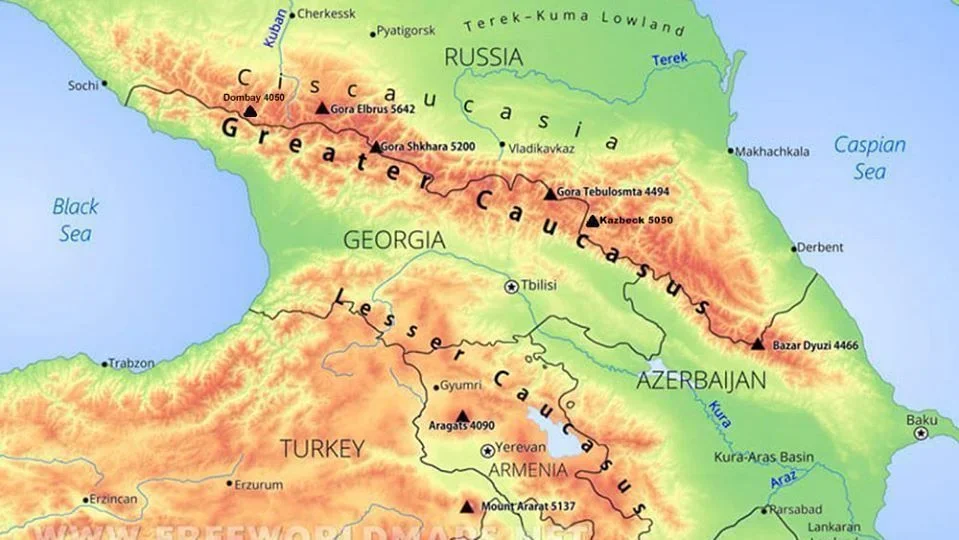
The Caucasus comprises the countries of Turkey, Azerbaijan, Georgia, and Russia, and is located between the Caspian Sea and the Black Sea.